



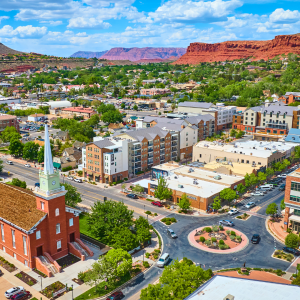
 Drive south toward St. George and Utah begins to change.
The Wasatch Front gives way to red cliffs, open desert, dramatic elevation changes, and communities shaped by an entirely different landscape. The visual contrast is striking, but for engineers, the differences go much deeper than scenery. Southern Utah presents its own set of opportunities, challenges, and design considerations that require local understanding and thoughtful planning.
McNeil Engineering is excited to continue expanding its presence in Southern Utah. By adding Hedman Engineering to the McNeil team, we are strengthening our ability to serve St. George and surrounding communities with a broader range of engineering expertise and resources.
Southern Utah Demands a Different Perspective
Engineering is never one-size-fits-all because no two regions behave exactly the same way. Climate, terrain, soils, development patterns, water needs, and community expectations all influence how a project should be approached.
In Southern Utah, those factors create an especially distinctive environment. A successful project must respond to the land rather than simply placing a design on top of it. That means understanding how development interacts with steep grades, exposed terrain, drainage paths, intense sun, and the visual character that makes the region so recognizable.
Good engineering begins with paying attention to those conditions before design decisions are finalized.
St. George Is More Than a Growing Market
St. George has become an increasingly important center for development in Utah, but its appeal goes beyond construction activity. The region combines neighborhoods, commercial centers, recreation, tourism, education, healthcare, and access to some of the most recognizable landscapes in the West.
That mix creates interesting challenges for engineers. Infrastructure must support the practical needs of a growing community while respecting the character that attracts people to Southern Utah in the first place.
Roadways need to move people efficiently. Utilities need to support expanding development. Structures must respond appropriately to site conditions, and landscapes need to make sense in an environment where water and long-term maintenance require careful consideration.
These systems cannot be designed independently. They work best when they are considered as pieces of the same community.
Local Knowledge Has Real Value
Technical expertise is essential in engineering, but understanding a region can be just as valuable.
Local knowledge helps teams recognize patterns that may not be immediately obvious on a plan. It can provide context about development practices, construction conditions, community expectations, and the practical realities of completing projects in a particular market.
That is one reason McNeil Engineering is so excited about expanding its Southern Utah presence through Hedman Engineering. The partnership brings together McNeil’s multidisciplinary resources with established regional experience in the St. George area.
For clients, that combination creates an opportunity to access broader capabilities while maintaining the kind of responsive, hands-on service that strong engineering relationships depend on.
Civil Engineering Begins With the Land
Southern Utah makes the importance of site-sensitive civil engineering easy to see. The terrain itself often becomes one of the most influential elements of a project.
Grading, roadway alignment, drainage, utilities, access, and site circulation all need to respond to existing conditions. Small decisions can influence how much earthwork is required, how naturally a development fits into the landscape, and how effectively the site performs over time.
Careful planning can also help reduce unnecessary disturbance and create projects that feel more connected to their surroundings. In a place where the natural landscape is such a defining feature, that relationship matters.
Structural Engineering Meets a Unique Environment
Buildings in Southern Utah also need to respond to their surroundings. Structural engineering must account for the demands of each individual project while supporting the architectural vision and practical realities of construction.
The strongest structural solutions are rarely the most complicated ones. They are solutions that efficiently transfer loads, work with the selected materials, coordinate with other disciplines, and provide dependable long-term performance.
As McNeil expands its presence in the region, Southern Utah clients can benefit from access to a broader structural engineering team while still receiving service grounded in local experience.
Landscape Architecture Takes on New Meaning
Few places demonstrate the relationship between landscape architecture and environment as clearly as Southern Utah.
Trying to recreate a landscape designed for a completely different climate rarely produces the best result. Successful landscape architecture in the region requires an understanding of water use, plant selection, shade, pedestrian comfort, long-term maintenance, and the surrounding visual environment.
A thoughtful landscape can complement the colors and textures of the desert rather than competing with them. It can create comfortable gathering spaces, guide movement through a development, and help a project feel like it belongs where it was built.
This is where engineering and landscape architecture become closely connected. Drainage, grading, utilities, pathways, and planting all influence one another.
Surveying Helps Reveal What the Site Is Telling Us
Before a project can respond intelligently to the land, the team needs to understand what is actually there. Accurate surveying provides that foundation.
Modern surveying and laser scanning technologies allow project teams to capture detailed information about terrain, boundaries, elevations, existing improvements, and other site conditions. That information becomes especially valuable on sites with significant topographic variation or complicated existing conditions.
Better information at the beginning supports better decisions throughout design. It helps teams identify constraints earlier and develop solutions based on the reality of the site rather than assumptions.
Growth Creates an Opportunity to Think Long Term
Expansion brings excitement, but it also creates responsibility. Decisions made during periods of growth can shape communities for decades.
A roadway built today may eventually carry far more traffic than it does at opening. A utility network may support development that has not yet been imagined, while commercial and residential areas may evolve as community needs change.
Engineering provides an opportunity to think beyond immediate construction and ask what those systems may need to do in the future. Designing with flexibility does not mean trying to predict every change. It means avoiding decisions that unnecessarily limit tomorrow’s options.
That long-term perspective is particularly important in communities that are actively evolving.
Growing Alongside Southern Utah
McNeil Engineering’s expansion in Southern Utah represents more than a larger geographic footprint. It is an opportunity to build new relationships, support growing communities, and bring additional multidisciplinary resources to projects throughout the region.
By joining forces with Hedman Engineering, McNeil is combining regional knowledge with expertise across civil engineering, structural engineering, surveying, consulting, and landscape architecture. That creates a stronger platform for serving clients in St. George and throughout Southern Utah.
We are excited about what comes next.
Southern Utah is a remarkable place to live, work, build, and explore. As its communities continue to evolve, McNeil Engineering looks forward to being part of that story by helping create projects that respect the landscape, serve the people who call the region home, and perform reliably for years to come.