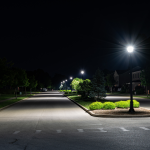




Here’s a fresh angle we have not used before. I went with what engineering looks like after dark, which also gives you a very different visual direction for the eventual blog image: illuminated walkways, a nighttime plaza, roadway lighting, or a modern development photographed at blue hour.
What Changes When a Project Goes Dark
A site can feel completely different after sunset. The roads, walkways, parking areas, entrances, and gathering spaces have not moved, but the way people experience them changes almost immediately.
Visibility becomes limited, landmarks become less obvious, and people rely more heavily on lighting, contrast, pavement markings, and the physical layout of the site to understand where to go. At McNeil Engineering, this is a good reminder that successful design should not work only during ideal daytime conditions.
Nighttime Reveals a Different Side of Site Design
During the day, people can see across a property and understand its layout quickly. Buildings, landscaping, sidewalks, and roadways provide visual cues that help users orient themselves without much effort.
After dark, many of those cues become less obvious. A driveway that felt intuitive in daylight may become harder to identify, while a pedestrian route can feel completely different when surrounding areas are poorly illuminated.
Good site planning considers how people experience a property throughout the full day. The goal is not simply adding more light, but making circulation understandable when natural visibility disappears.
Lighting Is Part of the Experience
Lighting can influence how comfortable, safe, and welcoming a place feels. It can help identify building entrances, reinforce pedestrian routes, draw attention to intersections, and separate areas intended for vehicles from those intended for people.
Too little lighting can create uncertainty, but more lighting is not automatically better. Excessive brightness can produce glare, make neighboring areas feel darker by comparison, and contribute to unnecessary light spilling beyond the property.
Effective design is about placing the right amount of light in the right locations. That requires coordination between site design, architecture, landscape planning, electrical systems, and the actual patterns of movement through the property.
Drivers Need Different Information at Night
Driving through an unfamiliar property becomes more demanding after dark. Drivers have less time to recognize turns, locate entrances, see pedestrians, and interpret how traffic should move.
Roadway geometry, pavement markings, signs, curbs, landscaped islands, and lighting all help reinforce those decisions. When these elements work together, a driver can understand the intended route without needing to process too many competing signals.
This becomes especially important at intersections, parking lot entrances, roundabouts, and locations where vehicles interact with pedestrians. Small design decisions can have a noticeable effect on how comfortable those movements feel at night.
Pedestrians Experience the Site More Personally
A person inside a vehicle experiences a property very differently from someone walking through it. Pedestrians move more slowly, are more exposed to their surroundings, and often notice details that drivers barely register.
A dark gap between two well-lit areas can make an otherwise reasonable pedestrian route feel uncomfortable. Poorly illuminated changes in elevation, curbs, steps, or pavement conditions can also become harder to recognize.
Thoughtful pedestrian design considers continuity. People should be able to move from parking areas to entrances, sidewalks, gathering spaces, and other destinations without suddenly entering confusing or poorly defined areas.
Landscape Architecture Changes After Sunset
Landscape architecture is usually photographed during the day, when color, texture, and planting are most visible. Yet many landscapes take on an entirely different character at night.
Trees can frame illuminated pathways, low lighting can help define gathering spaces, and carefully planned fixtures can highlight landscape features without overwhelming the environment. The relationship between light and planting can also influence visibility at intersections and along pedestrian routes.
Designers need to think about how vegetation will mature around lighting equipment. A fixture that performs perfectly when trees are young may become obstructed years later if canopy growth was never considered.
Parking Lots Become Navigation Systems
Parking areas are among the places where nighttime design becomes especially noticeable. During the day, people can often see entrances, available spaces, pedestrian routes, and building destinations from across the lot.
At night, those same users rely much more heavily on lighting and layout. Consistent illumination, visible pedestrian connections, recognizable building entrances, and clear circulation can help reduce hesitation and unexpected vehicle movements.
The parking lot effectively becomes a navigation system. If the design communicates clearly, people know where to drive, park, and walk without stopping to decipher the property.
Stormwater Does Not Care What Time It Is
Nighttime conditions also remind us that engineering systems need to perform even when people cannot easily see them. A storm occurring after dark still needs effective drainage, reliable infrastructure, and safe routes through the property.
Standing water can become more difficult for drivers and pedestrians to recognize at night. Poor drainage near walkways, parking areas, or entrances can therefore create problems that feel more significant when visibility is reduced.
This is another reason grading and drainage should be considered as part of the user experience, not simply as technical requirements. Infrastructure affects how people interact with a site under every condition.
Dark Skies Are Part of the Design Conversation
Outdoor lighting also affects what happens beyond the property boundary. Light that escapes upward or outward can contribute to skyglow, create glare for neighbors, and reduce the visibility of the night sky.
This issue is particularly relevant in communities where natural landscapes and dark skies are part of the area’s identity. Thoughtful fixture selection, positioning, shielding, and intensity can help provide necessary illumination without lighting areas that do not need it.
The goal is balance. A site can support safety and visibility while still respecting its surroundings and using light more intentionally.
Emergency Access Must Remain Clear
Some of the most important nighttime users of a site may arrive unexpectedly. Fire departments, ambulances, police, maintenance crews, and utility personnel may need to navigate a property quickly under difficult conditions.
Clear access routes, recognizable addresses, unobstructed circulation, and properly planned site features can all support emergency response. The easier a property is to understand, the less time responders need to spend figuring out where they are supposed to go.
This is another example of engineering working quietly in the background. Most people may never think about emergency circulation until the moment it becomes critically important.
Good Nighttime Design Is Often Subtle
The most successful nighttime environments rarely feel dramatically engineered. Instead, they simply feel easy to understand.
People can find the entrance, recognize where to cross, navigate the parking area, and move through the site without constantly questioning where they should go. The lighting supports the design rather than becoming the design itself.
That subtlety requires careful coordination. Civil engineering, landscape architecture, architecture, utilities, accessibility, and lighting all influence how the property performs after sunset.
Designing for the Other Half of the Day
Buildings and infrastructure do not stop functioning when daylight disappears. Restaurants become busier, residential communities remain active, employees leave offices, deliveries continue, and people move through public spaces well into the evening.
At McNeil Engineering, we believe good design means considering how a project performs under a wide range of real-world conditions. Daylight is only one of them.
The next time you enter a property at night and immediately know where to drive, where to park, and how to reach the entrance, consider everything quietly working together to make that experience possible.
Sometimes great engineering becomes easiest to appreciate after the sun goes down.